
Cuisine
DINING AND WINING WITH A NAMIBIAN FLAIR
Namibia’s cuisine is an eclectic mix of customs derived from Germany, South Africa and of course Namibian traditions and ingredients. At lodges, hotels, restaurants and eateries that cater for foreign tourists, visitors will be familiar with most of what is on the menus.
Since livestock are reared entirely on natural grazing, Namibian meat is free of artificial stimulants and of a high quality. It’s not an exaggeration to say, “Namibia is meat country,” with a choice between free-ranging game and succulent beef, especially steak.
Gemsbok (Oryx gazella), springbok and kudu are served smoked, as carpaccio, pâté, steaks or in casseroles. Zebra, eland and warthog feature less frequently on menus.
Seafood is a speciality in the coastal towns of Lüderitz, Walvis Bay, Swakopmund and Henties Bay. Oysters and black mussels are popular starters, while rock lobster from Lüderitz and calamari feature on various menus. Cob, also known as kabeljou, has a firm texture and heads the list of line fish. Other fish dishes include steenbras, kingklip, hake and sole.
Namibian delicacies such as omajova and Kalahari truffels are seasonally available. Omajova is the Otjiherero name for a large edible mushroom which grows at the base of termite hills in the central parts of the country shortly after the first summer rains. Sautéed in butter it is an excellent accompaniment to steak. The Kalahari truffle, a fungus known as the !Naba by the Nama people, grows in the Kalahari sands after rains. These truffles can be cooked whole, sliced and fried in butter, or used in a delicious soup.
The German culinary tradition is still strongly represented in Namibia. Typical German dishes include Eisbein (smoked pork shank), Rouladen (beef roll) and Kassler (salted and smoked pork chops) usually served with Sauerkraut (sour cabbage). Kartoffelsalat (potato salad), Rotkohl (red cabbage), Bratkartoffeln (pan-fried potatoes) and Spätzle (egg noodles) are popular side dishes. Some restaurants serve a traditional German Tagesessen (a dish of the day) at lunchtime.
Then there’s the almost endless variety of German-style cold meats, hams, sausages, salami and snacks produced locally by Hartlief and Windhoek Schlachterei to the highest standards. Raith Gourmet also makes a wide variety of meat products. Typical German products include Leberwurst (a liver spread), Bratwurst made from pork or veal, Bierwurst, a Bavarian-style pork, beef and game sausage, which does not contain any beer despite its name. Jagdwurst, or hunter’s sausage, is made from pork and beef, to mention but a few.
The German baking tradition is also still alive and well in Windhoek and many small towns. Brötchen (the German equivalent of bread rolls, but more crusty) with a variety of fillings are popular as a breakfast or lunch snack. Brötchen with filling are known as belegte Brötchen and may come with the typical German Rohhack – raw mince, salt, black pepper, onion and gherkins.
The Willi Probst Bakery, Boulevard Café and Restaurant, which has been a landmark in Walvis Bay since it opened its doors in August 1957, offers what is undoubtedly the largest selection of Brötchen with a choice of more than 50 fillings.
There’s also a wide choice of German Brot (bread) made from top quality whole rye grain. Three different types of grain are used in Dreikorn, while Katenbrot is made from a mixture of wheat and rye flower with added sunflower seeds. Pumpernickel is a very dark, course wholemeal bread with a strong flavour. Bauernbrot (farmer’s bread) is made with sour dough.
For those with a sweet tooth there’s a wide selection of mouth-watering cakes and pastries. Indulge in a slice of Schwarzwälder Kirschtorte (Black Forest cake – a chocolate sponge cake with a cherry filling and cream) or Sachertorte (Austrian chocolate cake). Or tuck into Apfelstrudel (sliced apples wrapped in pastry) and Käsekuchen (cheese cake).
German Stollen, a rich fruit and nut loaf, is popular at Christmas. Lebkuchen (German gingerbread in different designs), Pfeffernüsse – which true to their name contain pepper, plus a mixture of honey, cinnamon, allspice and ground cloves) and Zimtsterne (cinnamon stars) are among the wide variety of cookies that are available during the Christmas season.
THE EVER-POPULAR BRAAI
At social gatherings, the traditional braai (barbecue) is a popular way of entertaining. It usually includes a combination of meat cuts, chicken, sosaties (skewered meat) and sausage cooked over the coals and served with salads. Potjiekos, a stew of beef, lamb or chicken and vegetables cooked in a cast-iron pot over an open fire is another popular dish. Other delicacies include skilpadjies and pofadder which are made from cubes of lambs liver wrapped in caul fat and cooked over the coals. Skilpadjies (little tortoises) are named for the resemblance of the parcels to the shell of a tortoise when they are roasted, while pofadder, which is shaped like a sausage, resembles the puff adder snake.
NAMIBIAN FARE FOR THE ADVENTUROUS PALATE
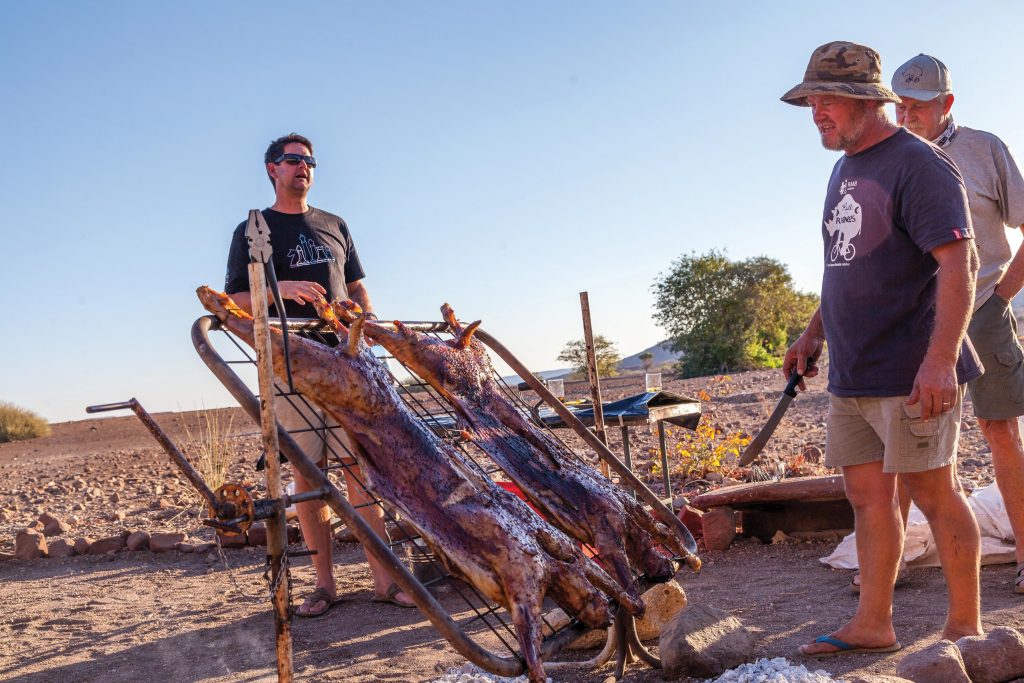
If you are looking for Namibia’s national dish and true street food, you need to make your way to an open-air market in Windhoek or any of the towns in the north of the country to buy kapana. These strips of beef which are grilled over the coals are named after the chilli spice that is sprinkled over them. Kapana has become so popular that a local bank, Nedbank, has been sponsoring a national kapana cook-off, where vendors can showcase their cooking skills, since 2015. Another typical Namibian dish, the Smiley, is a goat’s head cooked over an open fire. It is ready when the flesh around the teeth becomes soft and tender. And if you are more adventurous you can try some mopane worms, which are named after the leaves of the tree that the caterpillars feed on. Typical Namibian dishes from the north of the country include omahangu (pearl millet), the staple dish in the north and ekaka, wild spinach harvested in the mahangu fields. Also popular is oxuxwa, a dish made from chicken fried in nutty- tasting marula oil. Restaurants in the north usually feature local dishes on their menus. In Windhoek you can feast your taste buds on traditional fare at Xwama Traditional Restaurant in Katutura. Also well worth a visit is Hafeni Traditional Restaurant in Swakopmund’s Mondesa township.
PROST!
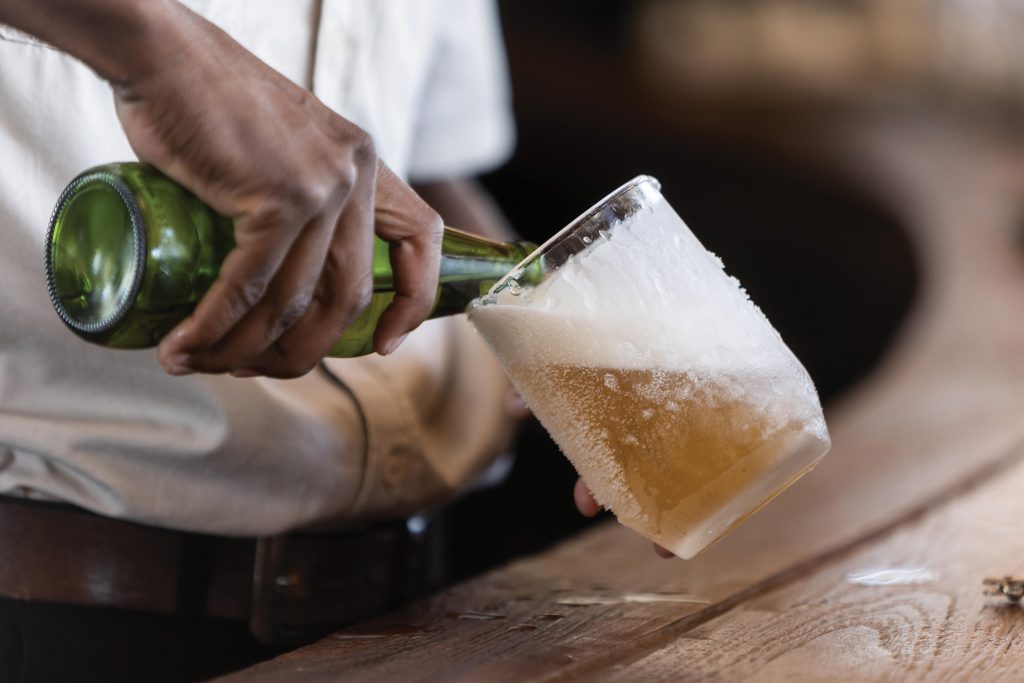
Namibia’s beer drinking tradition dates back to the arrival of German soldiers and officials in the late 1880s. Four breweries, two in Windhoek, one in Omaruru and one in Swakopmund, amalgamated in 1920 to form the South West Africa Breweries – renamed Namibia Breweries after independence. NBL was recently aquired by Heineken.
The company’s beer is brewed in accordance with the German Reinheitsgebot (Purity Laws) issued by the Duke of Bavaria in 1516, and only the purest malted barley, hops, yeast and water are used. No grains or cereals and no chemical additives, stabilizers, sugar or preservatives may be used. The brewery’s extensive range includes the Windhoek and Tafel brands, Hansa draught, King Lager (the first beer brewed from home-grown Namibian barley), Heineken and Erdinger.
CRAFT BEERS
Beer lovers can also enjoy a wide range of craft beers. The Camelthorn Brewing Company, Namibia’s first independent brewery, produced its first range of craft beers in 2009. It was acquired by Namibia Breweries in 2014 and its range includes Urbock – a traditional ‘bock’ beer with a sweet taste and an alcohol content of 7%. It is traditionally brewed for the winter months to meet the demand for a stronger beer and is usually served at room temperature.
The Swakopmund Brewing Company in the Strand Hotel’s Brewer and Butcher restaurant has been producing a range of craft beer since the hotel opened in 2015. Also at the coast are the Namib Dunes Craft Brewery at Swakopmund and the Skeleton Coast Brewery at Henties Bay.
In Windhoek craft beer is produced by two micro- breweries. Helles, Indian Pale Ale and a limited edition beer is brewed by Tholch Brewery. The on-site brewery at the Roof of Africa Hotel has a range for four beers – Helles, Indian Pale Ale and a limited edition Roof Reef Draught, Roof Unfiltered Draft, Roof Pilsner, Roof Dark Lager.
MARKETS
Locally produced cheese, meat products, organic vegetables and other Namibian delicacies are available at several markets in Windhoek and elsewhere. The Green Market, also known as the Bio-Markt, in Windhoek is the first organic market in the country. A variety of organically grown vegetables and meats, cheese and fresh farm produce is sold at the market held at Dr. Kenneth David Kaunda Street in Klein Windhoek every Saturday from 07:30 to 12:15.
The Village Sunday Market at 18 Liliencron Street in Windhoek is held on Sundays only. The market has evolved into a vibrant gathering that supports small businesses and offers a platform for recognition and growth for talented musicians. Diverse stalls showcase a myriad of artistic expressions. But it is the culinary delights that truly take centre stage with artisan bread, fresh organic produce and aromatic herbs and spices on offer.
Despite its hot and dry climate, conditions in Namibia are surprisingly ideal for growing olives. Ruheleben Estate and Shalom Farm, in the Swakop River valley, produce cold pressed virgin olive oil and olives. Noab Olive farm is further inland, in a valley along the Remhoogte Pass.
The Swakop River valley is famous for delicious asparagus from the Swakopmund Asparagus Farm. A wide variety of fresh vegetables are also grown on smallholdings along the valley.
LIFT YOUR SPIRITS
Namibian distilleries produce a variety of uniquely hand- crafted spirits made from indigenous plant products. How about trying some Eembe liqueur made from the fruit of the Jackalberry tree, or the Essence of Namibia (a liqueur made from a mixture of ginger and aniseed and Devil’s Claw) – both from the cellars of Erongo Mountain Winery at Omaruru. The winery also distils Grappa from the skins of red grapes.
Kristall Kellerei at Omaruru also produces grappa, Nappa, as well as Matisa, a prickly pear liqueur, and Lumela, a liqueur made from the corky monkey orange. Naute Kristall, situated on the C12 to Naute Dam, has been operating since 2014. It produces NamGin, NamGlint (a gin liqueur) and NamRum which is flavoured with Devil’s Claw. The Copper & Coal Distillery Company in Walvis Bay produces a range of four gins which contain a variety of herbs, spices and local plant products such as Devil’s Claw and Marula fruit.
Stillhouse Atlantic craft distillery at Swakopmund produces a range of local gin infused with a variety of herbs, spices and indigenous ingredients such as the !Nara and Devil’s Claw.
IN VINO VERITAS
It comes as a surprise to many visitors that Namibia with its arid and hot climate has wineries. As these wineries are small-scale, production is limited, but the wines are available in selected bottle stores and restaurants.
The country’s first wine was produced as far back as the early 1900s at the Catholic mission station in Klein Windhoek. The cellar initially produced communion wine because of the prohibitive cost of importing the wine from Germany. The range was later expanded to include a semi-sweet and a dry white wine, as well as brandy (locally nicknamed Katholischer), which was sold commercially. Production stopped in the 1980s.
The country’s first commercial winery, Kristall Kellerei, was established in Omaruru on the banks of the Omaruru River in 1990. The first harvest was five years later. It produces a red blend and two white Colombard wines.
Also in Omaruru is the Erongo Mountain Winery which produced its first vintage in 2014. Its range includes four red blends, three white wines and a sparkling wine made from the corky monkey orange.
Thonningii Wine Cellar in the Otavi valley produced its first wines in 2005. Its range consists of a white and a red blend as well as Shiraz, Tinta Barocca, Barbera and a Shiraz rosé.
What started off as a hobby for retired businessman Allen Walkden-Davies with the first planting of vines at Neuras in the foothills of the Naukluft mountains in 1998, has expanded over the years. The farm was bought by the N/a’an kus ê Foundation in 2012. The range consists of three red wines.
A wide range of wines from South Africa and other wine-producing countries is sold in retail stores and bottle stores and is available in restaurants.