
People of Namibia
RESPONSIBLE TOURISM
- Respect the customs and traditions of your hosts.
- Support local people and their products by spending your money within the local economy.
- Bargain fairly.
- Don’t insult Namibians by turning them into beggars.
- Try to learn a new local word every day, and be open to friendship.
- Keep the realities of the economy in mind. Even though Namibia is a developing country, the hotels and lodges are graded according to international standards, hence prices will more or less tally with international prices.
- Namibians are very relaxed people, so please be patient with them!
Best-culture practice
- It is polite to begin conversations with a courteous greeting.
- If you wish to stay in a traditional village, request permission from the headman.
- If you want to draw water from a community well, permission must be sought.
- In a Himba village it is disrespectful to walk between the sacred fire and the kraal (animal enclosure) or the headman’s hut.
- Show respect when approaching a traditional Herero or Himba grave, often indicated by an array of cattle horns.
LOCAL LINGO
The following words are typical local vernacular, influenced by Afrikaans – still largely the lingua franca – and other indigenous languages. Using these words will do much to improve your communication with locals.
- aweh – said in excitement. The word has many meanings and uses, including hello, goodbye, and yes
- bakkie – a pickup truck
- biltong – dried and seasoned meat (like jerky), a popular snack
- braai – a barbecue.
- Braaing – a national pastime that traditionally entails turning the meat with one hand while holding a beer in the other – is taken very seriously
- brötchen – a bread roll, offered with different toppings, to be eaten as breakfast, lunch, supper or a snack
- dorp – small town
- droëwors – dried sausage, a snack often eaten with biltong
- efundja – periodic flood in the Owambo regions, northern Namibia
- eish! – an interjection expressing resignation
- jol – to have fun, to party
- just now / now-now – meaning anytime within the next 50 years other than right at this moment
- kapana – traditionally barbecued meat, usually sold in the townships and at the side of the road
- lekker – nice, good, great, tasty, awesome
- mémé – respectful form of address for an adult female
- iishana – shallow pools and watercourses in the Owambo regions, northern Namibia
- pap – traditional maize porridge
- plaas – farm
- potjie – a three-legged cast-iron pot used for cooking stews over the fire
- robot – a traffic light
- shebeen – an informal bar, open 24 hours
- sosatie – meat (traditionally lamb) and vegetable pieces on skewers, usually accompanying other meat on a braai
- táté – respectful form of address for a male
- vetkoek – deep-fried bread dough, often sold with kapana
- wors – spicy sausage for accompanying meat on a braai
- yoh – an expression of surprise
TIPS FOR PHOTOGRAPHING PEOPLE
- Make friends with the locals. If you are planning on taking photos of them in their private surroundings, it is always best to have a local guide take you around to converse with them and overcome the barrier of photographer versus subject.
- Always ask before you photograph someone. Not everybody likes to have his or her picture taken, so avoid conflict by asking first.
- Some people will expect payment for having their picture taken. This includes the Himba and Herero people, who still dress traditionally and are thus interesting subjects. They spend considerable time and effort on their appearance and if you ‘steal’ their image without asking their permission and offering payment, it might make them angry and put you at a disadvantage. The best option is to ask them first and agree on a price before taking the photo.
- Young children are often fond of being photographed, but it is always best to ask a guardian or parent first.
- Older people might be more hesitant to have their picture taken. Once again, with friendliness you will achieve more.
- If you take a digital photograph of someone, show it to him or her afterwards. Many people don’t own cameras and are amazed by the possibilities of technology. This gesture will make them warm to you, and might result in you taking a great photograph.
- If possible, try to send a copy of the picture to the person you have photographed. Those living in rural areas will truly appreciate it. But don’t promise to do so and then not deliver. If you are not sure whether you will get round to sending the photo, rather not make the promise.
- Remember that it is illegal to take photos of men and women in uniform, except when they are performing in a public parade, or something similar. Taking a picture of a police officer on duty is therefore out of the question.
- When taking photos at a cultural village, at a cultural performance, or on a pre-arranged photographic tour, it is not necessary to ask permission. To be on the safe side, check with your guide or local companion first.
- When on an organised tour, many photo opportunities are pre-arranged, making it easy for you to just snap away, while leaving the formalities to your guide. Ask your guide about this if you are not sure.
KEY PHRASES IN SOME OF THE LOCAL LANGUAGES
Afrikaans
Setswana
Silozi
Kavango
Oshiwambo
Otjiherero
Nama/Damara
San
ART AND CRAFTS
The first artists of Namibia were the San, whose rock art can be viewed in shelters on mountains and hills throughout the country. Today, relative to its small population, Namibia has a surprisingly large and active community of artists and craftspeople.
- The National Art Gallery of Namibia (NAGN) and the Arts Association Heritage Trust (AAHT) have comprehensive permanent collections of Namibian art that can be viewed by the public.
- The Katutura Community Art Centre (KCAC) offers a wide range of training programmes for young artists and houses the John Muafangejo Art Centre, an NGO that also offers training programmes and exhibition space for young artists.
- Work by contemporary artists and craftspeople can be viewed and purchased in galleries, craft centres, at urban and rural street markets and along roadsides. The biggest of these is the Namibia Craft Centre (NCC) in Tal Street, Windhoek.
Traditional crafts include woodcraft from Kavango and Zambezi; Owambo, Kavango, Zambezian and Himba baskets; and San eggshell jewellery. Embroidery and appliqué work, wall hangings and carpets woven from karakul wool feature native designs of trees, animals and birds.
ARCHITECTURE
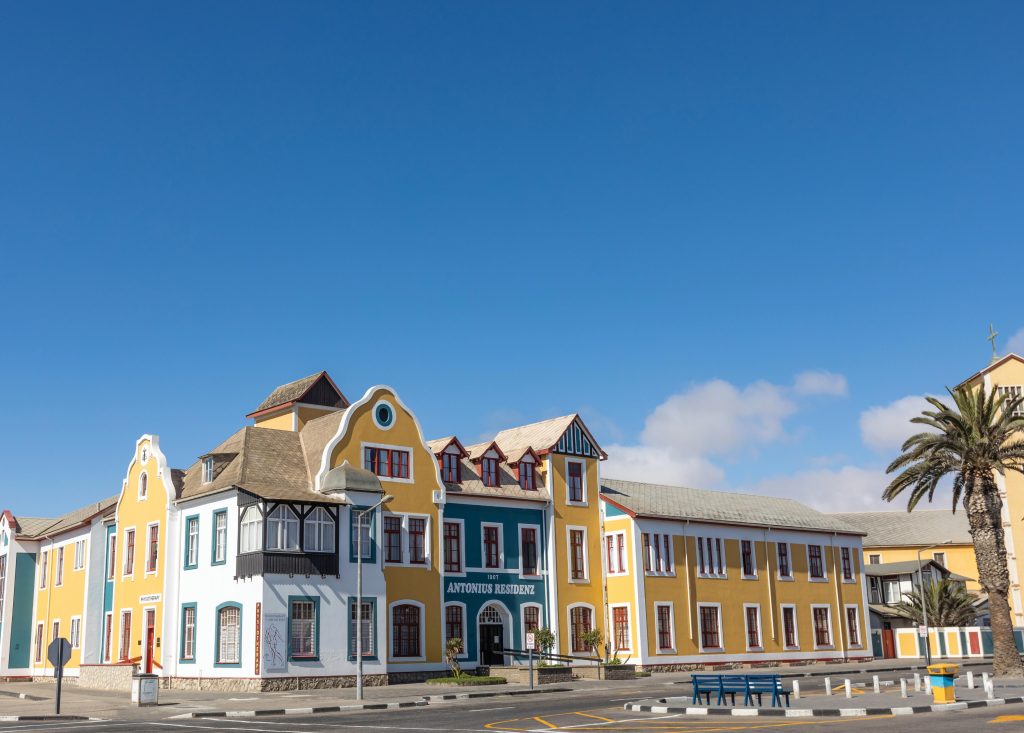
The German colonial architecture found in many of Namibia’s towns contrasts with the open expanses of African bush and savannah. Residences with wide, shady verandas reflect European architectural styles of the time, adapted to the local climate.
In Windhoek, Swakopmund and Lüderitz many of these earlier buildings have been renovated as government offices, libraries and research facilities. New developments follow the post-modern movement, echoing the German colonial style, but with the emphasis on shape and colour.
CULTURAL ACTIVITIES
Cultural development is promoted by institutions such as the National & Mobile Museum, the Museum Association of Namibia, the National Art Gallery of Namibia, the National Theatre of Namibia, the College of the Arts, the Art Department at UNAM and the Bank Windhoek Namibia Theatre School.
Showcasing the traditions of the many different groups that coexist in the country are:
- Namibian cultural groups performing customary African dances to rhythmic drumbeats.
- The COTA Youth Choir and Voices of Namibia choir, with singers drawn from different cultural groups singing songs that originate from all over of the country.
- Multicultural events that include exhibitions, dance and music concerts featuring Namibian and foreign artists.
- The cultural activities of diplomatic missions have expanded the cultural dimensions of Namibians considerably, and helped promote rural art abroad. The Franco-Namibian Cultural Centre (FNCC) has been particularly active by organising different cultural activities and supporting all art disciplines. It regularly presents film screenings and courses in French, English, art, photography and cooking.
- Annual events on the arts calendar: The Windhoek Jazz Festival stages an array of local and international artists.
- The /Ae//Gams Arts and Cultural Festival usually takes place during the first week of September at various venues throughout the city. The event showcases Namibia’s artistic and cultural diversity through music, cuisine, traditional attire, dance and song, contemporary visual arts, crafts, theatre and poetry.