
Namibia's Environment
NAMIBIA’S MAIN TOPOGRAPHICAL REGIONS:
DISTINCTIVE MOUNTAINS
- Brandberg – highest, western Erongo
- Moltkeblick – second highest, Auas range, south of Windhoek
- Bismarckfelsen – third highest, south of Windhoek
- Gamsberg – fourth highest, table-topped, Khomas Hochland, southwest of Windhoek
- Mount Etjo – south of Otjiwarongo
- Spitzkoppe – most imposing peaks, Erongo Region
- Omatakos – twin-peaked, between Okahandja and Otjiwarongo
- Erongo Mountains – between Usakos and Omaruru
- Naukluft Mountains – massif, Namib-Naukluft Park
- Waterberg Plateau – east of Otjiwarongo
- Brukkaros Mountain – crater-like, halfway between Mariental and Keetmanshoop
- Dicker Willem – conspicuous inselberg, towards the west near Aus
RIVERS
Namibia is the most arid country in southern Africa, with water being a key resource.
Perennial rivers:
- Orange River, forms the southern border
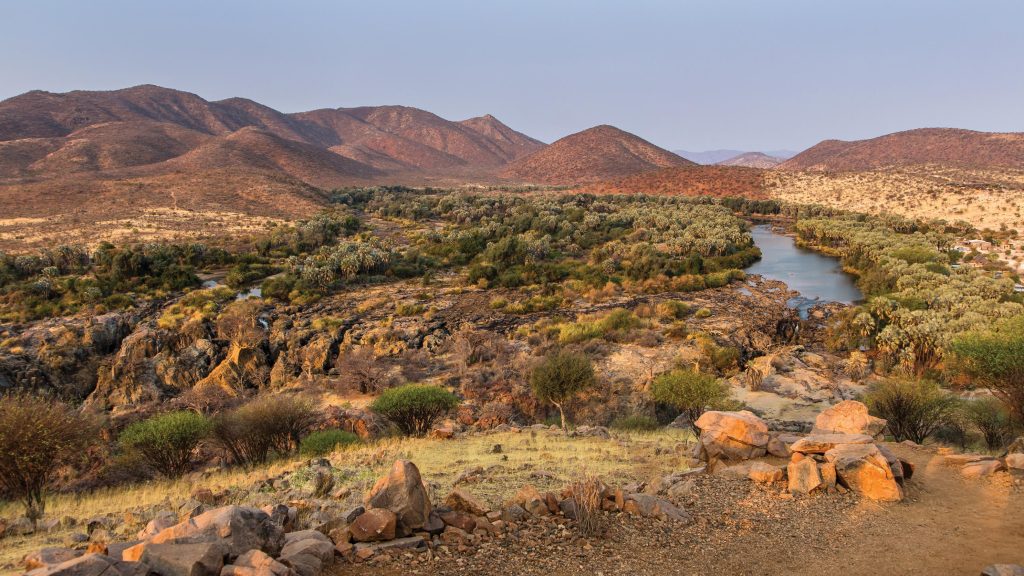
- Kunene, in the northwest
- Okavango, Zambezi & Kwando/Linyanti/Chobe, in the northeast
Major ephemeral/seasonal rivers:
- Fish and Nossob, tributaries of the Orange Kuiseb, Swakop, Omaruru, Hoarusib, Hoanib, Ugab and Khumib, all west-flowing and draining into the Atlantic
- Tsauchab, landlocked, with floodwaters occasionally feeding Sossusvlei
- Marienfluss and Omatako, north-flowing
- Cuvelai, a drainage system of rivers originating in southern Angola, with floodwaters flowing into the Etosha Pan.
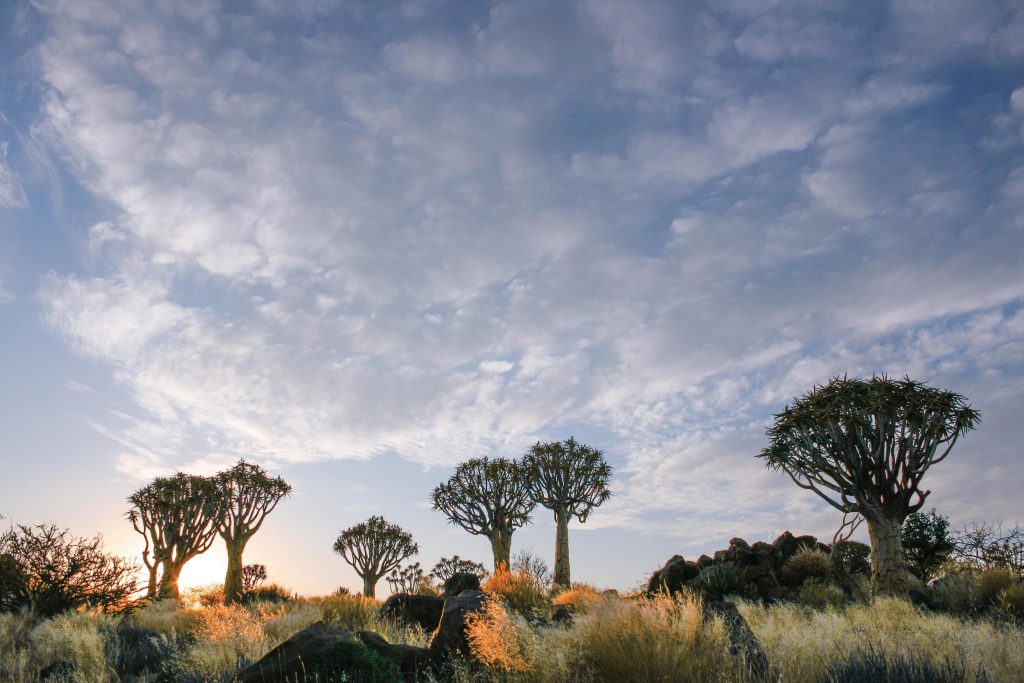
CLIMATE
- Typical of a semi-desert country, with droughts a regular occurrence.
- Namibia is the most arid country in southern Africa, with a humidity of less than 10% during the winter months and varying from 50% to 80% during the summer.
- Except for the south-western areas where winter rainfall occurs, rain usually falls during the southern-hemisphere summer.
Rainy season
- Short – October/November to December
- Main – January to March.
Average annual rainfall
- 50 mm and less, along the coast in the west
- 350 mm, central highlands
- 700 mm, far north-eastern areas
Temperatures
- Days – mostly warm to very hot, summer from 20–34°C, in winter average day temperatures vary from 18–22°C.
- Nights – generally cool, dropping to ± 18°C, average from 0–10°C, as low as -8°C.
- Interior – lower than in pre-Namib due to altitude.
- Coast and hinterland – moderate due to influence of the cold Benguela Current, causing the typical fog of the coast, reducing rainfall in the rest of the country.
FLORA
Namibia’s plant-life is categorised into 14 vegetation zones:
- Desert
- Semi-desert
- Mopane
- Mountain
- Thorn bush
- Highland
- Dwarf shrub
- Camel-thorn
- Mixed tree and shrub savannahs
- Forest savannahs and woodlands
- Golden expanses of African grasslands, dotted by solitary acacias, typified by stretches of silvery grass after rains
Fast facts on flora
- Namibia has 195 plant families, with over 4,300 species, subspecies and varieties. Areas of particularly high diversity include the Succulent Karoo, Kaokoveld, Otavi/Karstveld area, Okavango Basin and Khomas highlands.
- Over 1,000 species are endemic or near-endemic to Namibia or the Namib.
- The Namib hosts over 100 species of lichen, several endemic.
- Namibia’s most noteworthy plant, the Welwitschia mirabilis, is endemic to the Namib Desert and one of the oldest plants known to man.
FAUNA
Namibia’s abundant wildlife is arguably its greatest tourist asset.
Fast facts on fauna
- The country hosts eight endemic mammal species.
- Over 20 antelope species,
- A wealth of small mammals, including mongoose and jackal; the less common, solitary and nocturnal aardvark; and the honey badger.
- The Namib Desert is world-renowned for its large number of endemic dune-dwellers, especially lizards, including 30 endemic species.
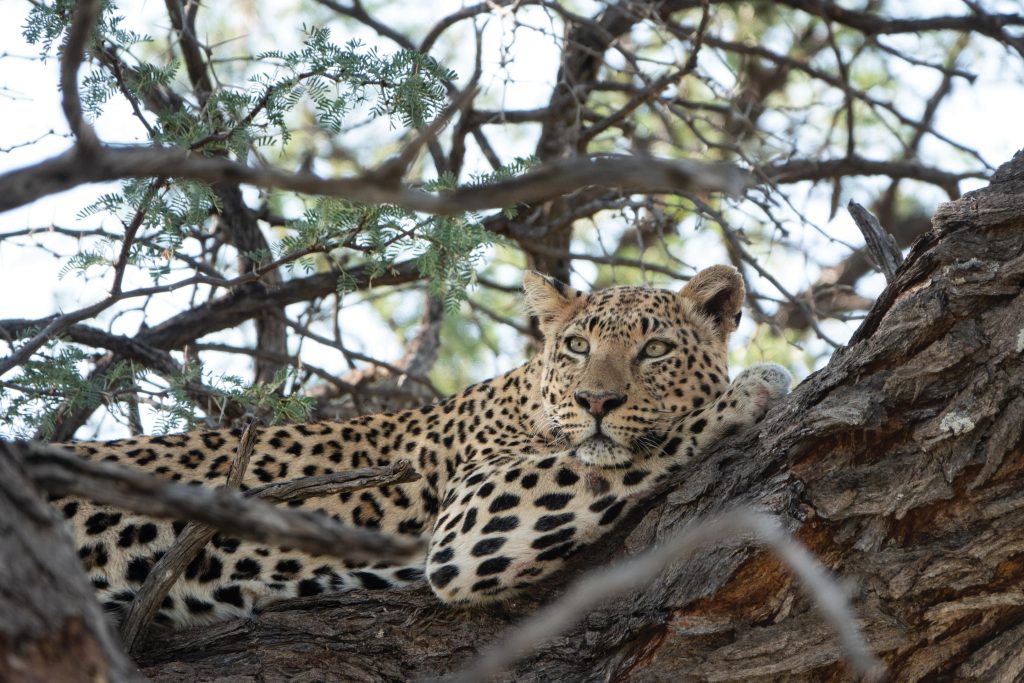
- Large game species are elephant, rhino, giraffe, buffalo, lion, leopard and cheetah.
- Endangered mammals are wild dog, cheetah, black rhino, lion, puku, oribi and waterbuck.
BIRDS
Of 887 bird species recorded for southern Africa, 676 occur in Namibia. About 500 breed locally, the rest migrate; 11 species are near-endemic, with over 75% of world populations found in Namibia.
Special near-endemics
- Herero Chat
- Rockrunner
- Monteiro’s Hornbill
- Damara Tern
Namibia’s only true endemic is the Dune Lark.
For detailed information, refer to Atlas of Namibia – A Portrait of the Land and its People by John Mendelsohn, Alice Jarvis, Carole Roberts & Tony Robertson.
CONSERVATION AND ECOTOURISM
Namibia was the first country in the world to include the protection of the environment in its constitution. Today approximately 46.6% of its surface area is protected, either as a national park, game reserve, conservancy or other form of state protected area, exceeding the 10% prescribed by the IUCN.
- The protection of rare and endangered species was boosted in 1972, when Waterberg Plateau Park was proclaimed a sanctuary and breeding ground for animals such as white rhino, eland, buffalo, roan and sable antelope and tsessebe.
- Protection of the black rhino in the western arid regions gained momentum in the early eighties. Today Namibia is one of the few countries in Africa with growing populations of the highly endangered black rhino, within as well as outside national parks.
- The first Marine Protected Area – stretching 400 km along the coast and 30 km offshore, incorporating 10 islands – was established in 2009. This will be expanded to encompass the entire coastline (excluding towns), as the Namib-Skeleton Coast National Park, set to be the eighth largest park in the world and the largest in Africa.
- In the private sector several NGOs assist the Government with conservation and development. These include the Namibia Nature Foundation, Save the Rhino Trust, Cheetah Conservation Fund, AfriCat Foundation, and the Namibian Association of Community Based Natural Resource Management (CBNRM) Support Organisations, an association comprising 15 non-governmental organisations (NGOs) and the University of Namibia (UNAM).
- Certain game ranches and lodges focus especially on the conservation of certain species of wildlife on their farms. The largest private conservation area in Namibia is the NamibRand Nature Reserve, an area of over 180 000 ha situated south of Sesriem. Others are the Gondwana Canyon Park in the south, Erindi Private Game Reserve in the central plateau area, the Huab Private Nature Reserve in the northwest, and AfriCat North in the north. A total of 161 private game reserves are registered with the MEFT.
Venture Media, the publisher of Namibia Holiday & Travel, also publishes Conservation and the Environment in Namibia annually, containing the latest information on conservation efforts by the MEFT and NGOs in Namibia. www.conservationnamibia.com
CONSERVANCIES
The objective of a conservancy is to reinstate the area’s original biodiversity and share resources among all conservancy members.
Communal conservancies are managed by the local communities in each region. They provide employment and allow people to benefit directly from their wildlife and other natural resources.
Today there are 86 registered communal conservancies in Namibia, which add 20.2% to Namibia’s protected area network. There are also 43 community forests which cover 10.3% of Namibia’s land.
With the addition of communal conservancies and community forests to state-protected land, the total land available to wildlife is around 45.6% of Namibia.
Find out more here: www.nacso.org.na
ENVIRONMENTAL MANAGEMENT
After independence in 1990, a Directorate of Environmental Affairs (DEA) was established in the Ministry of Environment, Forestry and Tourism to actively promote and maintain the welfare of the people.
- Namibia, as a signatory to several international environmental treaties, has introduced a number of groundbreaking programmes and policies aimed at tackling environmental challenges while implementing national development goals.
- Desertification is Namibia’s most pressing environmental concern.
- Other issues are deforestation, overgrazing, soil erosion, bush encroachment, climate change, loss of groundwater resources and decreasing crops.
- Threats related to mining and habitat and biodiversity loss have also been highlighted as areas of concern.
ENVIRONMENTAL INVESTMENT FUND
The Environmental Investment Fund (EIF) of Namibia provides economic opportunities and a stake in the use of natural resources to the impoverished sectors of Namibian society.
RECYCLE NAMIBIA FORUM
As a private-public sector partnership, the Recycle Namibia Forum (RNF) is aimed at promoting the 3 Rs (Recycle, Reuse and Reduce) for products through projects and networking.
NAMIBIAN CHAMBER OF ENVIRONMENT
The Namibian Chamber of Environment (NCE) is an umbrella Association that provides a forum and mouthpiece for the broader environment sector, that can lobby with government and other parties, that can raise funds for its members and represent the sector. The Chamber aims to become a financial (and other) resource centre, sponsored by industry, but at the same time keeping industry at arm’s length and ensuring complete independence. Many environmental specialists work in remote areas, often alone or in small groups with little in the way of support structures. The Chamber aims to provide support to such individuals and organisations.
NON-GOVERNMENTAL ORGANISATIONS
The Namibia Nature Foundation (NNF) is Namibia’s leading nongovernmental environmental organisation. Other NGOs that aim to support the environment are the Desert Research Foundation of Namibia (DRFN), which incorporates the Desert Ecological Research Unit (DERU); the Namibia Institute for Sustainable Development (NISD); the Namib Desert Environmental Education Trust (NaDEET); Integrated Rural Development and Nature Conservation (IRDNC); and the Namibia Association of CBNRM Support Organisations (NACSO). One of Namibia’s longest-standing NGOs is Save the Rhino Trust (SRT), founded in 1982. Others worth mentioning are the Cheetah Conservation Fund (CCF); the AfriCat Foundation; N/a’an ku sê; Harnas; the Namibia Animal Rehabilitation, Research and Education Centre (NARREC); the Namibia Environmental and Wildlife Society (NEWS); the Large Carnivore Management Association of Namibia (LCMAN); the Elephant Human Relations Aid (EHRA); the World Wildlife Fund (WWF); the Namibia Development Trust (NDT); and the Southern African Institute for Environmental Assessment (SAIEA).
STRATEGIC ENVIRONMENTAL ASSESSMENT (SEA)
SEAs in Namibia offer a well-developed methodology for improving strategic decision-making and integrating environmental issues into policies, plans and programmes. The country’s Environmental Management Act (EMA) of 2007 stipulates mandatory environmental assessments for a number of policies, plans and programmes. An Environmental Commissioner’s office was established within the MEFT.
PRIVATE GAME RESERVES
Private landholders in Namibia have played a significant role in the conservation of wildlife by establishing conservation initiatives on their land.
- The NamibRand Nature Reserve, a vast area of around 180 000 ha situated south of Sesriem, is a scenically beautiful conservation area created by the late Windhoek businessman, Albi Brückner.
- The Erongo Mountain Nature Sanctuary encompasses an area of almost 180 000 ha, protecting a unique wilderness reserve with the Erongo Mountains at its centre.
- In southern Namibia the Gondwana Collection has established four private nature reserves (about 197 000 ha combined).
- Also in the south is the Sandfontein Nature Game Reserve, which extends over 76 000 ha.
- The Erindi Private Game Reserve (79 000 ha) in central Namibia is home to over 20 000 animals.
- Situated in the upper reaches of the Huab River, the Huab Private Nature Reserve (8 060 ha) provides a sanctuary for the desert-dwelling elephants of the area.
- Fischer’s Pan Private Game Reserve (7 000 ha) lies east of Etosha National Park.
- The 34 000 ha Onguma Nature Reserve adjoining Etosha National Park, harbours many of the mammals and birds found in Etosha.
- Founded in 1999, Etosha Heights is one of the largest private reserves in Namibia, sharing a 65-kilometre boundary with the famous Etosha National Park. The reserve offers 60,000 hectares of unspoiled wildlife. This reserve has transitioned from an agricultural and hunting area to what is now a conservation success story. The result has been a significant increase in both variety and density of wildlife.
At present there are about 200 private game reserves registered in Namibia.
HUNTING AND HUNTING SAFARIS
Guided by strict ethical standards set and encouraged by the Namibia Professional Hunting Association (NAPHA), hunting is intrinsically part of the Namibian culture. The country’s hunting activities have evolved into a highly specialised wildlife industry, with trophy hunting playing a crucial role in managing wildlife populations and contributing significantly to the GDP. www.napha.com.na
TRANSFRONTIER CONSERVATION AREAS
The concept of TFCAs (Transfrontier Conservation Areas) has rapidly gained momentum in SADC countries such as Namibia, Angola, Mozambique, Botswana, South Africa, Zimbabwe and Zambia. TFCAs are transfrontier wildlife sanctuaries that embrace crossborder conservation areas and game parks. www.peaceparks.org
The Namibian Government is firmly committed to the transfrontier process and has achieved cross-border agreements with several countries. Namibia established its first TFCA, the /Ai-/Ais Richtersveld Transfrontier Park, in 2003, with South Africa as co-signee. About 70% of the 6 046 km² park is situated in Namibia, comprising the /Ai-/ Ais Hot Springs Game Park, the Hunsberg conservation area, the Huns Mountains, Fish River Canyon and /Ai/Ais Hot Springs.
A Memorandum of Understanding between Namibia and Angola was signed in 2003 to establish the Iona Skeleton Coast Transfrontier Conservation Area, encompassing 31 540 km² of the northern Namib coastal desert.
Officially launched in 2012 and spanning over 444 000 km² (similar in size to Sweden), the Kavango-Zambezi Transfrontier Conservation Area (KAZA) is the world’s biggest conservation area, comprising national parks, game reserves, forest reserves, conservancies, game/ wildlife management areas and communal lands in Angola, Botswana, Namibia, Zambia and Zimbabwe. www.kavangozambezi.org
LINK YOUR TRIP WITH A VISIT TO NEIGHBOURING COUNTRIES
Visitors to Namibia travelling to neighbouring countries must ensure that they comply with the latest immigration, customs and other cross-border requirements.
SEE FOUR OF OUR FIVE NEIGHBOURS
Visit the Kavango-Zambezi Transfrontier Conservation Area (KAZA) and see Angola, Botswana, Namibia, Zambia and Zimbabwe.
TO BOTSWANA
Fly with FlyNamibia from Windhoek to Maun or Windhoek to Katima Mulilo (Mpacha Airport) for a safari in Chobe National Park or on to the Okavango Delta.
OR Travel from Windhoek to Maun and the Okavango Delta through the Muhembo border post.
OR Link a self-drive safari through the Kalahari in eastern Namibia with a visit to the Kgalagadi Transfrontier Park in South Africa and Botswana.
TO SOUTH AFRICA
Fly from Windhoek to Cape Town or Johannesburg on any of the frequent scheduled flights.
OR Link a self-drive safari to southern Namibia with a visit to the Richtersveld in South Africa.
OR Link a self-drive safari through the Kalahari in eastern Namibia with a visit to the Kgalagadi Transfrontier Park in South Africa and Botswana.
TO ZIMBABWE
Fly with FlyNamibia from Windhoek to Victoria Falls.Include Victoria Falls in a self-drive safari from Katima Mulilo in the Zambezi Region through Botswana’s Chobe National Park – a journey of about 220 km.
TO ZAMBIA
Include Livingstone and Mosi-oa- Tunya (Victoria Falls) in a self-drive safari that visits the Zambezi Region.
TO ANGOLA
Fly from Windhoek’s Hosea Kutako International Airport to Luanda.
OR Include Iona National Park, Angola, in a self-drive itinerary to northern Namibia.